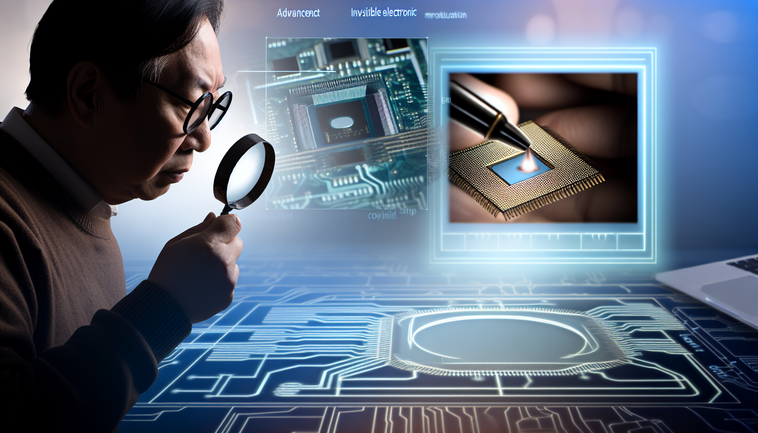
In the relentless pursuit of packing more computing power into less silicon, every nanometer counts. Engineers and designers have long chased the dream of microchips so compact they verge on invisibility, promising slimmer gadgets, blazing speeds, and lower costs.
A research team at Johns Hopkins University, in collaboration with partners around the world, has unveiled a pioneering approach that may finally make that dream a reality. By combining light-directed patterning with specialized metal-organic compounds, they’ve devised a way to sculpt circuits at scales previously thought unreachable.
At the heart of this advance lies a synergy between focused beams of light and custom-built metal-organic materials. When these materials meet the beam, they undergo precise chemical changes, allowing for layer-by-layer assembly of circuitry with nanometer precision—far beyond the limits of traditional lithography.
The immediate payoff could be dramatic: processors that churn through data more quickly, battery-powered devices that sip energy, and production lines that slash per-unit costs. In an era where speed and affordability define technology adoption, this breakthrough could tip the scales toward more ubiquitous computing.
Beyond the laboratory benches, the implications for manufacturing are equally profound. Chemical liquid deposition simplifies equipment needs, potentially shrinking factory footprints and reducing the environmental toll of semiconductor fabrication. Smaller tools and fewer harsh chemicals could translate into greener, more flexible production models.
Of course, turning a lab-born innovation into a staple of the chip-making industry involves hurdles. Scaling up the process, ensuring consistency across large wafers, and integrating with existing fabrication standards will demand further research and collaboration. Yet, the Johns Hopkins team’s early results suggest these challenges are surmountable with focused investment and interdisciplinary effort.
As this technique matures, we may find ourselves interacting with devices so small that their presence becomes almost imperceptible—a testament to human ingenuity and an invitation to imagine what comes next. In that future, the line between the physical and the digital could blur even further, ushering in a new age of seamless, powerful, and nearly invisible electronics.